Non-surgical rhinoplasty in Southampton.Reshaping without surgery.
Proportion and balance, achieved through placement rather than removal.
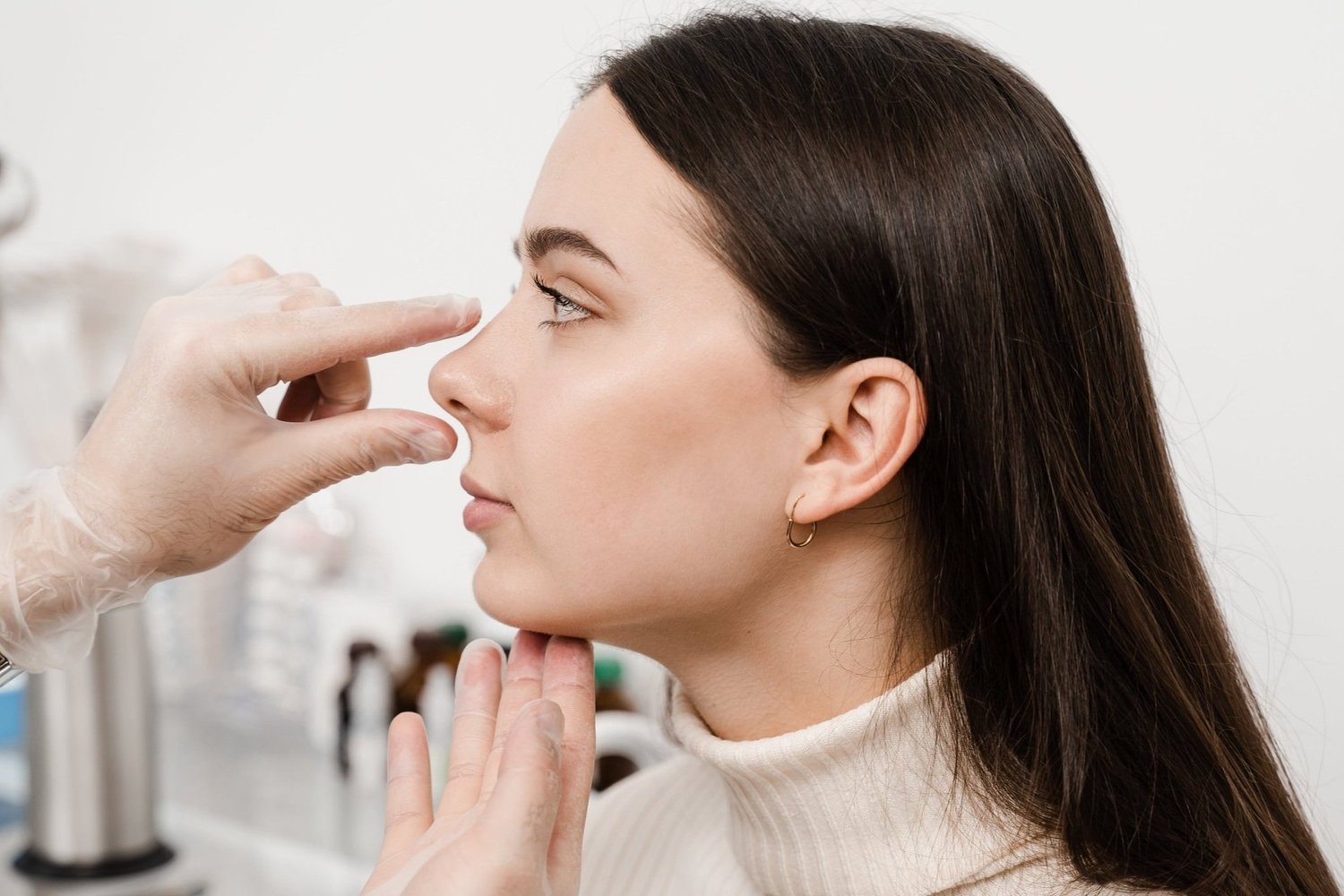
- Session length
- 45 minutes
- Sessions
- Typically one
- Results
- Immediate, read fully at 2 weeks
- Downtime
- Minimal; possible bruising
Non-surgical rhinoplasty is a dermal filler treatment that reshapes the nose without surgery, offered at Skin Aesthetics by Krystian in Bursledon, Southampton in a single 45-minute appointment, with results visible immediately and reading fully at two weeks, minimal downtime in most cases, and suiting patients whose concern is a specific structural feature such as a dorsal bump, a drooping tip, or a lack of definition, rather than those seeking a significant reduction in the size of the nose, which filler cannot achieve.
Pricing and booking are on Fresha, kept in one place so it is always current.
Strategic placement. Proportion corrected without surgery.
Non-surgical rhinoplasty uses small, precise deposits of dermal filler to alter the visual profile of the nose. By adding volume in specific anatomical locations, a practitioner can straighten a dorsal bump by creating an illusion of a smoother bridge line, lift a drooping tip, improve symmetry, or add definition to a flat profile. No tissue is removed and no incisions are made. The change is achieved through geometry: what is added in one place alters the apparent relationship between all the surrounding structures.
This is one of the highest-stakes injectable treatments on the aesthetic menu, not because it is inherently dangerous, but because the nose contains dense vascular anatomy that demands specific knowledge and immediate access to emergency protocols. Krystian does not treat this area without a full anatomical assessment at consultation, and the enzyme used to dissolve hyaluronic acid filler in the event of a vascular complication is always present in the treatment room. This is not a treatment to shop for on price.
What it can and cannot do. Honest expectations, set before treatment begins.
Filler adds volume; it does not remove it. Non-surgical rhinoplasty can make a prominent nose appear more refined by improving its proportions relative to surrounding features, but it cannot make a large nose smaller. Patients presenting with this expectation will be told so at consultation, and the conversation about whether surgical rhinoplasty is the appropriate route will be had without agenda. What filler does well is address a specific, defined feature: the bump on the bridge, the drooping at the tip when smiling, the slight deviation that reads as asymmetry. These are problems of proportion and profile, and proportion and profile respond to placement.
Krystian uses a fine needle and a cannula interchangeably depending on the specific area being treated, with cannula technique preferred for areas of higher vascular risk. The product selected is a hyaluronic acid filler appropriate for the structural support the nose requires, one that integrates well and can be dissolved if necessary. Every treatment in this area ends with a review of vascular blanching signs and a brief monitoring period before the patient leaves.
Results are immediate and continue to settle over two weeks as minor swelling resolves. The treatment typically lasts twelve to eighteen months, depending on the area treated, the product used, and individual metabolism. Some patients return for a maintenance or refinement session before the filler has fully dissolved; others wait for the product to clear and reassess. Both approaches are appropriate depending on how the result has settled.
Three things assessed before placement.
Vascular anatomy, realistic outcomes, and existing filler history are all reviewed at consultation.
Anatomical risk profile
The nose has a dense and variable vascular supply, including the angular, dorsal nasal, and lateral nasal arteries, all of which sit close to the surface in areas commonly treated with filler. Krystian maps these structures relative to the patient's individual anatomy before treatment and selects technique and needle type accordingly. Patients with a history of previous rhinoplasty, surgical or non-surgical, have altered anatomy and are assessed with additional care.
Realistic outcomes
The consultation will establish clearly what this treatment can achieve for your specific nose. A dorsal bump can be camouflaged by straightening the apparent bridge line; a rounded or drooping tip can be lifted and defined; a flat bridge can be given more dimension. A nose that is large relative to the face cannot be made smaller with filler, and Krystian will say so directly if that is the presenting expectation.
Existing filler history
Patients who have had non-surgical rhinoplasty elsewhere, particularly with unknown or permanent products, require a different assessment. Layering filler on an unknown substrate increases both the vascular risk and the likelihood of an irregular result. Krystian may request that existing filler is dissolved and the area assessed at baseline before new treatment is agreed.
Forty-five considered minutes, anatomy first.
The session gives as much time to assessment as to treatment, because in this area, preparation is the work.
Arrival and consent
Medical history is reviewed and any changes noted. The treatment plan agreed at consultation is confirmed, and consent is taken with the opportunity to ask any outstanding questions. Photographs are taken from multiple angles for the clinical record.
Anatomical assessment and mapping
Krystian assesses the nose under good lighting, palpating the tissue and mapping the areas to be treated. Vascular landmarks are identified, the planned injection points are marked, and the approach for each area, needle or cannula, is decided. This takes longer than patients expect and is not hurried.
Treatment
The filler is placed in small, precise deposits across the planned areas. Each placement is assessed before proceeding to the next. Krystian checks for vascular blanching at regular intervals during the treatment. The change to the profile is visible as placement progresses and is reviewed with the patient using a mirror mid-session if appropriate.
Review and aftercare
The result is reviewed from multiple angles. Minor asymmetry from swelling is distinguished from structural asymmetry that warrants addressing in the session. Aftercare instructions are given verbally and in writing, and a two-week review appointment is scheduled before you leave.
The honest version.
The questions every patient is too polite to ask out loud. Read at your pace.
Is non-surgical rhinoplasty safe?
It is a treatment with a genuine risk profile that is managed, not eliminated, by practitioner skill and preparation. The primary risk is vascular occlusion, where filler enters or compresses a blood vessel, which can cause tissue damage if not identified and treated immediately. Krystian treats this area only with a dissolving enzyme immediately available, uses anatomically informed technique, and monitors for vascular signs throughout and after the session. Patients should be cautious of any practitioner offering this treatment without discussing these risks explicitly.
Will I see results immediately?
Yes. The change to the nose profile is visible from the moment treatment ends, though swelling in the first 24 to 48 hours means the final result is best read at two weeks when everything has settled. Occasional bruising can occur, particularly around the tip and bridge, and this typically resolves within seven to ten days.
How long do results last?
Most patients see results lasting twelve to eighteen months, though this varies with the area treated, the product used, and individual metabolism. The tip of the nose tends to metabolise filler more quickly than the bridge. Krystian plans maintenance timing with each patient individually based on how the result settles at the two-week review.
I had rhinoplasty done elsewhere. Can I come to Krystian?
Patients with previous non-surgical rhinoplasty are assessed differently, particularly if the product used previously is unknown or if permanent filler was placed. In some cases, the existing material will need to be dissolved and the area reviewed at baseline before new treatment is agreed. Krystian will discuss this at consultation and will not layer filler on an unknown substrate.
Where can I see the pricing?
Pricing and booking are on Fresha. The reserve-your-consultation button on this page takes you directly there.
What we tell you before we begin.
- BruisingPossible at injection points, typically resolving within seven to ten days.
- SwellingExpected for 24 to 48 hours post-treatment; the final result reads at two weeks.
- Vascular occlusionA serious but rare complication where filler affects blood supply to surrounding tissue; managed by immediately dissolving the filler with an enzyme that is always present in the treatment room.
- AsymmetryMinor swelling-related asymmetry resolves; structural asymmetry is assessed at the two-week review.
- ExclusionsPregnancy, breastfeeding, active skin infection in or around the nose, blood-clotting disorders, and patients with unknown or permanent filler from previous treatments (assessed individually).
The consultation is where Krystian will review your anatomy honestly and tell you whether this treatment is appropriate for your specific concern, or whether a different approach is more suitable.
Reserve your consultation.
If you have a specific structural concern about your nose and want to understand what is possible without surgery, the consultation is the right place to start. It is £30, taken off your first treatment, held at the clinic in Bursledon, and carried out without any pressure to proceed.