PRP in Southampton.Renewal from your own biology.
The raw material is already in your bloodstream. Treatment is a matter of concentrating it and returning it where it is needed.
- Session length
- 45-60 minutes
- Course
- 3 sessions, 4 weeks apart
- Results read
- Gradually from 4 weeks
- Downtime
- Redness 12-24 hours
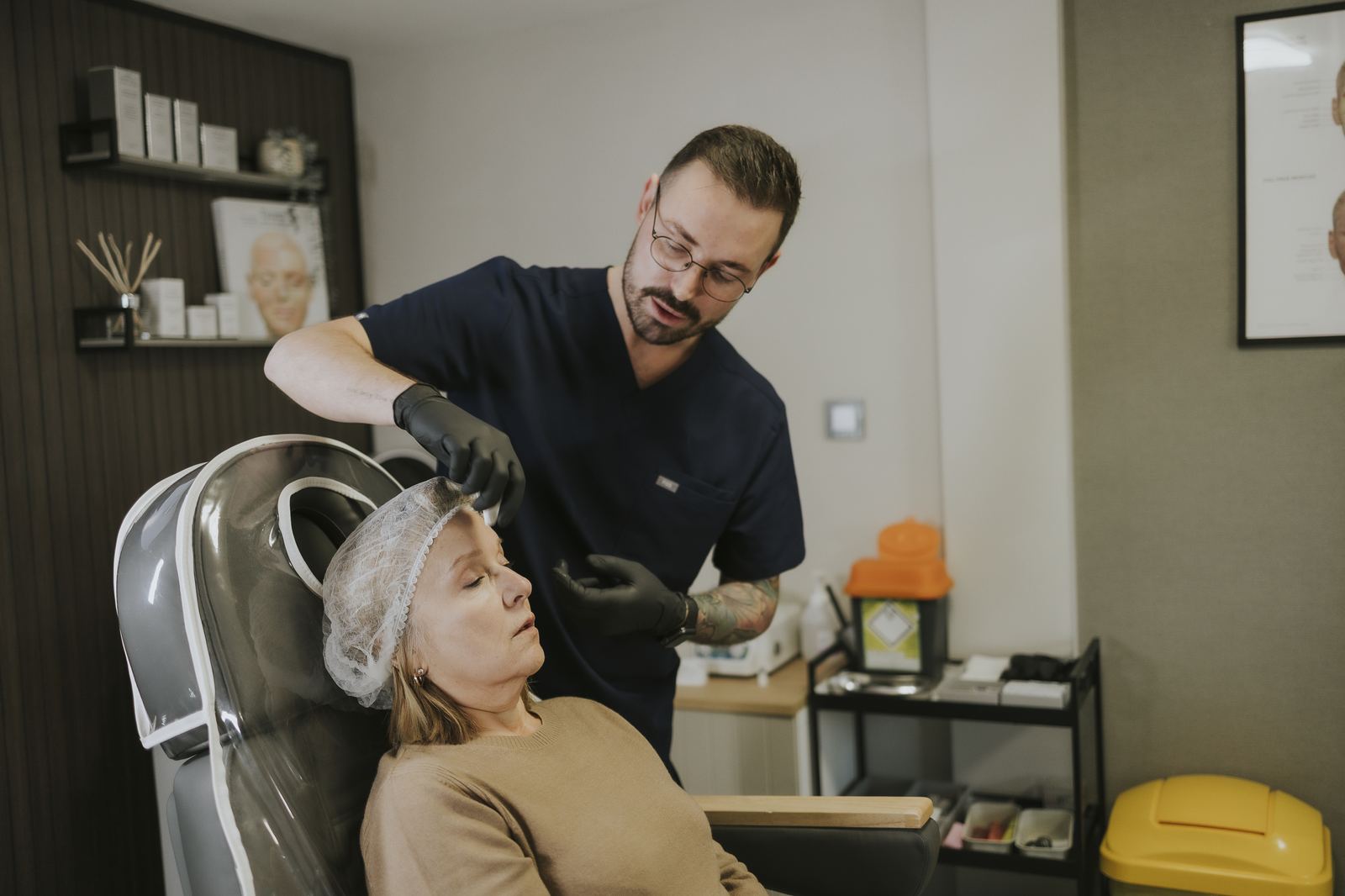
PRP, or platelet-rich plasma, is an injectable treatment using a concentrated fraction of the patient's own blood to stimulate collagen production and tissue repair, offered at Skin Aesthetics by Krystian in Bursledon, Southampton in appointments of 45 to 60 minutes including the blood draw and processing time, with results building gradually from four weeks and reading most fully after the complete course, minimal downtime for most patients, and suiting those looking to improve skin quality, texture, and early laxity rather than those seeking a volumising or contouring treatment.
Pricing and booking are on Fresha, kept in one place so it is always current.
Your own growth factors. Returned to the skin in concentration.
Platelet-rich plasma, known as PRP, is derived from a small sample of your own blood. The sample is placed into a sterile centrifuge, which separates the blood by density into its component layers. The platelet-rich layer is isolated, drawn off, and prepared for reintroduction into the skin. Platelets contain a range of growth factors, including platelet-derived growth factor, transforming growth factor, and vascular endothelial growth factor, each of which plays a role in stimulating fibroblast activity, promoting collagen synthesis, and supporting the formation of new blood vessels. The treatment introduces nothing foreign; it concentrates what is already present in your blood and delivers it where the tissue can use it.
PRP is primarily a treatment of skin quality rather than skin volume. It improves the texture, tone, and density of the dermis over time through the sustained action of growth factors stimulating cellular repair. Patients notice changes in skin luminosity, a reduction in fine surface lines, and improved evenness of texture across repeated sessions. The result is gradual and cumulative, not immediate, which is an important distinction from volumising or repositioning treatments. PRP suits patients whose skin has lost quality and vitality rather than those primarily concerned with structural loss.
PRP for scalp and hair. The same mechanism, a different application.
The growth factors concentrated in platelet-rich plasma have been studied for their role in stimulating dormant hair follicles and prolonging the active growth phase of the hair cycle. Scalp PRP is offered as a treatment for thinning hair related to androgenic alopecia or diffuse non-scarring hair loss. The blood draw and processing is identical to facial PRP; the placement, via microinjection across the scalp, is adapted for the target tissue. A course of three sessions is recommended, and results are assessed at three months from the first treatment.
The quality of PRP varies considerably based on the processing protocol and the centrifuge used. The platelet concentration achieved, the activation method, and the speed of reintroduction after processing all influence the biological activity of the final product. Krystian uses a clinical-grade centrifuge and a standardised processing protocol, and the product is placed into the skin within the window of optimal activity after preparation.
PRP works well as a standalone treatment and also as a complement to other interventions. It is frequently combined with microneedling to improve dermal penetration of the platelet concentrate, or used in the same treatment period as a filler or skin booster protocol. The consultation will establish whether PRP alone is the most logical starting point for your concern, or whether a combination approach is more appropriate.
Three things reviewed before your course.
Realistic expectations, platelet quality, and whether the scalp or facial presentation suits PRP are all established at consultation.
Expectations and timeline
PRP does not produce an immediate visible change. The growth factors stimulate a biological process that unfolds over weeks, and the improvement in skin quality builds across the course rather than being visible after a single session. Patients who are expecting a visible result within days of a single treatment are likely to be disappointed, and Krystian sets this expectation clearly at consultation before any treatment is booked.
Platelet quality and health factors
The effectiveness of PRP is directly related to the quality and quantity of platelets in your blood. Patients taking long-term anticoagulant medication, those with platelet disorders, or those who are significantly anaemic may not achieve the same platelet yield from the draw, which affects the potency of the treatment. These factors are reviewed at consultation and may inform whether PRP is the most appropriate choice or whether an alternative such as PRF or exosomes is more suitable.
Scalp versus facial presentation
The assessment for scalp PRP is distinct from the assessment for facial PRP. For scalp treatments, Krystian evaluates the pattern and likely cause of hair thinning, as PRP is most effective for androgenic and diffuse non-scarring loss and less likely to produce a significant result in cases of established scarring alopecia or thyroid-related loss. Where the cause of hair loss is unclear, investigation before treatment is the appropriate starting point.
Sixty considered minutes, including your blood draw.
The session includes the draw, processing time, and treatment, all within a single appointment.
Arrival and consent
Medical history is reviewed and consent confirmed. Photographs of the treatment area are taken for the clinical record. Any questions about the process are addressed before the blood draw begins.
Blood draw
A small volume of blood, typically 10 to 20ml, is drawn from the antecubital vein in the arm using a standard phlebotomy technique. The sample is placed into a sterile processing tube and transferred to the centrifuge immediately.
Processing
The centrifuge runs for a fixed protocol time to separate the blood into its density layers. While the sample processes, the treatment area is cleaned and, where appropriate, topical numbing cream is applied to allow adequate time to take effect before placement begins.
Placement and aftercare
The platelet-rich fraction is drawn from the processing tube and introduced into the treatment area via microinjection or via a microneedling pass, depending on the agreed protocol. After placement, the area is reviewed and aftercare instructions are given. The next session in the course is scheduled before you leave.
The honest version.
The questions every patient is too polite to ask out loud. Read at your pace.
Is PRP safe?
PRP is an autologous treatment, meaning it uses only material derived from your own body. The risk of allergic reaction or immune rejection is therefore negligible. The risks associated with PRP are those common to all injectable treatments: bruising, swelling, and discomfort at injection points. The blood draw itself carries the same minor risks as any venepuncture procedure. There are no synthetic substances introduced, and a very low risk of a foreign body reaction.
How many sessions do I need?
A course of three sessions at four-weekly intervals is the standard recommendation, as this allows the cumulative growth factor stimulus to build across the course rather than being a single event. Some patients with significant skin quality concerns or established hair thinning may benefit from a fourth session. Maintenance sessions, typically once or twice a year, are recommended to sustain the result once the initial course is complete.
When will I see a difference?
The first visible changes in skin quality, improved luminosity and a subtle improvement in texture, typically appear from four weeks after the first session. The result builds progressively across the course and is most accurately assessed at three months from the first treatment. Hair loss patients should not assess the result before three months, as the hair cycle takes time to respond.
How does PRP compare to PRF?
PRF, or platelet-rich fibrin, is a more recent evolution of platelet therapy that produces a fibrin matrix in addition to concentrated platelets, which allows for a slower, more sustained release of growth factors in the tissue. It requires no anticoagulant additives in the processing tube. Some studies suggest a higher growth factor concentration in PRF compared to standard PRP. Krystian offers both and will discuss which is more appropriate for your specific concern at consultation.
Where can I see the pricing?
Pricing and booking are on Fresha. The reserve-your-consultation button on this page takes you directly there.
What we tell you before we begin.
- BruisingPossible at injection points and at the blood draw site; typically resolves within seven days.
- Swelling and rednessExpected for 12 to 24 hours post-treatment; most patients can return to work the following day.
- Discomfort during placementMicroinjection across the face or scalp produces a stinging sensation; topical numbing is available where appropriate.
- InfectionRare when performed in a clinical environment with appropriate sterile technique.
- ExclusionsPregnancy, breastfeeding, platelet disorders or blood-clotting conditions, active anticoagulant therapy, haematological malignancy, active skin infection in the treatment area, and severe anaemia affecting platelet yield.
The consultation is where Krystian reviews your health history and will be honest about whether PRP is the most appropriate treatment for your concern, or whether a different intervention is better suited.
Reserve your consultation.
If you are looking to improve skin quality, luminosity, or address early thinning and want a treatment that uses your own biology rather than a synthetic product, the consultation is the right starting point. It is £30, taken off your first treatment, held in Bursledon by appointment, and without obligation.